Quick Answer
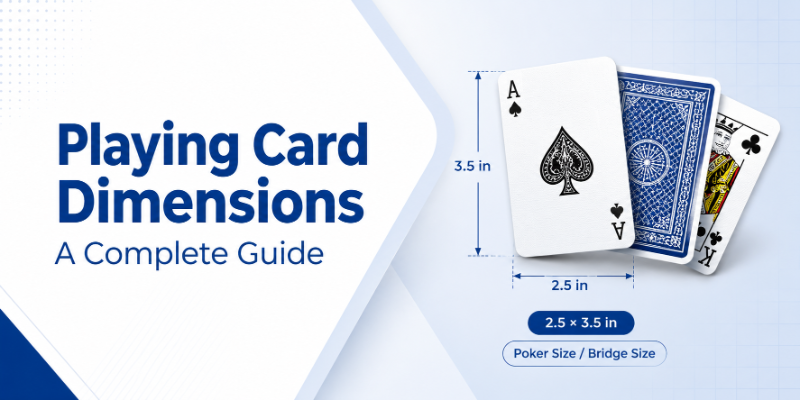
Standard poker-size playing cards measure 2.5 × 3.5 inches (63.5 × 89 mm), while bridge-size playing cards are narrower at 2.25 × 3.5 inches (57 × 89 mm). Trading cards like Pokémon and Magic: The Gathering typically measure 2.5 × 3.5 inches (63 × 88 mm), though Yu-Gi-Oh! cards are smaller at approximately 59 × 86 mm. These differences matter for deck box fit, sleeve compatibility, and tournament storage standards.
Introduction to Playing Card Dimensions
Card dimensions might seem like a minor detail, but they significantly impact gameplay, storage, collectibility, and manufacturing. Whether you’re designing a custom deck, printing trading cards, or running a gaming venue, understanding these measurements ensures your project meets industry standards and customer expectations.
The card industry isn’t standardized around a single size. Different games, regions, and purposes call for specific dimensions that have evolved for practical reasons. A casino card differs from recreational poker format. Trading card measurements vary by game publisher. Bridge size follows different specifications than the poker format.
This guide walks you through the full landscape of card sizing, helping designers, manufacturers, collectors, and business owners make informed decisions.
Understanding the Core Difference: Poker vs. Bridge Card Dimensions
This is where confusion often happens, so let’s clear it up immediately.
Poker-Size Card Dimensions
Poker cards measure 2.5 inches wide by 3.5 inches tall (63.5 × 89 mm). This wider format is commonly used for:
- Casual and serious poker games
- Professional casino play
- Many modern recreational and casino-style decks
- Standard trading cards (Pokémon, Magic: The Gathering)
The extra 0.25 inches of width makes poker-size cards easier for dealers to handle, shuffle efficiently, and control during rapid play.
Bridge Card Dimensions
Bridge cards are noticeably narrower at 2.25 inches wide by 3.5 inches tall (57 × 89 mm). Originally designed for bridge players (hence the name), this format is preferred for:
- Traditional card games requiring quick dealing
- Players with smaller hands
- Games where card fanning is important
- Vintage and specialty decks
The narrower width requires less table space and feels different in hand—many players find bridge cards easier to hold for extended sessions.
Why This Distinction Matters
The 0.25-inch difference might seem trivial, but it affects everything from deck box sizing to sleeve compatibility. A poker-size card won’t fit properly in a bridge-size deck box, and vice versa. If you’re ordering custom playing card boxes, specifying whether you need poker or bridge dimensions is crucial for fit and protection.
Poker Card Dimensions in Professional Settings
Casino Standards
Most casinos use poker-size cards at 2.5 × 3.5 inches, but they invest heavily in premium card stock. Professional casino cards feature:
- Card stock thickness: Usually 0.25–0.3 mm, providing rigidity and durability
- 100% plastic construction or plastic-coated paper for wear resistance
- Precision edge work enabling smooth shuffling and dealing
- Security features like microprinting or specific back patterns
Casino specifications are tighter than recreational decks because high-volume use causes faster wear. A gaming venue may use thousands of decks annually, requiring materials that withstand constant shuffling, bending, and exposure to moisture.
Tournament Play Requirements
Organized poker tournaments usually require consistent card size, finish, and quality so every player uses the same standard deck during play. This ensures fairness and prevents any competitive advantage from variations in card dimensions or wear patterns.
Trading Card Dimensions and Why Size Variations Matter
The trading card world uses multiple sizing standards, and understanding these differences is essential for collectors, players, and manufacturers.
Major Trading Card Games: Pokémon and Magic: The Gathering
Both Pokémon and Magic: The Gathering cards measure approximately 2.5 × 3.5 inches (63 × 88 mm)—essentially the same as standard poker-size playing cards. This sizing choice offers several advantages:
- Sleeve compatibility: Thousands of aftermarket sleeve options exist
- Deck box fit: Affordable, standardized storage solutions work perfectly
- Tournament integration: Players can use the same cases and storage for multiple games
- Collector infrastructure: Binders and protective slabs are widely available
Yu-Gi-Oh! Cards: A Different Standard
Yu-Gi-Oh! cards are noticeably smaller at approximately 59 × 86 mm. This creates practical consequences:
- Dedicated sleeves required: Standard trading card sleeves don’t fit properly
- Unique deck boxes needed: Off-the-shelf storage won’t work
- Separate binder pages: Yu-Gi-Oh! requires its own protective storage system
- Tournament regulations: Players must use tournament-legal deck boxes designed specifically for these dimensions
Why These Collectible Card Measurements Matter
When manufacturers choose trading card dimensions, they’re making a commitment that affects the entire ecosystem. Different card measurements mean:
- Higher costs for collectors buying sleeves and storage
- Reduced secondary market appeal if dimensions are unusual
- Tournament restrictions or non-compliance issues
- Difficulty in long-term preservation
Standard Playing Card Sizes: A Global Perspective
Jumbo and Large-Format Cards
Jumbo playing cards typically measure 3 × 4.5 inches and serve specific purposes:
- Magic trick illusions requiring visibility
- Table displays and promotional events
- Games for vision-impaired players
- Novelty and oversized deck collections
Large-format cards require different deck box sizing and custom packaging considerations.
Mini and Travel Playing Cards
Smaller versions at approximately 1.75 × 2.75 inches appeal to travelers and collectors seeking compact decks. These come with proportionally smaller deck boxes and usually simpler construction to keep costs down.
Tarot and Specialty Decks
Tarot cards typically measure 2.75 × 4.75 inches—notably taller than standard playing cards. This elongated format suits divination practices and appeals to collectors seeking distinctive visual presentation. Specialty decks for specific games might use entirely custom measurements based on game mechanics or brand differentiation.
Deck of Cards Dimensions and Packaging Considerations
Understanding deck sizing means looking beyond individual card dimensions to the complete package.
Individual Card Specifications
- Card dimensions: 2.5 × 3.5 inches (for poker-size) or 2.25 × 3.5 inches (for bridge-size)
- Card stock thickness: 240–350 gsm depending on quality tier
- Stack height: Approximately 0.6–0.7 inches for a complete 52-card deck
- Jokers and extra cards: Most decks include 2 jokers plus marketing cards
Deck Box Sizing
A properly fitted deck box protects cards during shipping and storage. Standard specifications include:
- Interior dimensions: Slightly larger than stacked card height to allow smooth card insertion and removal
- Card retention: Tuck flaps or lids that secure the deck
- Padding considerations: Many boxes include protective padding to prevent shifting during transit
- Exterior dimensions: Proportional to interior size plus box wall thickness
Working with an experienced packaging partner like Custom Boxes Lab ensures your deck boxes fit perfectly, whether you’re shipping standard poker-size cards or custom trading card decks.
Card Printing Dimensions and Technical Specifications
File Preparation for Card Printing
When preparing art files for card printing, you need to account for trim, bleed, and safety zones:
- Finished card size: 2.5 × 3.5 inches (for example)
- Design file size: 2.75 × 3.75 inches (includes 0.125-inch bleed on all sides)
- Bleed area: The 0.125-inch (3 mm) border that extends beyond the trim line, compensating for slight cutting variations
- Safety zone: Keep critical design elements (logos, text, important graphics) within 0.25 inches from the edge to prevent them from being cut off
Card Stock Selection for Playing Cards
| Card Stock Weight | Approx. Thickness | Best For | Durability |
|---|---|---|---|
| 240 gsm | ~0.2 mm | Budget decks, promotional cards | Low to medium |
| 300 gsm | ~0.25 mm | Standard recreational decks | Medium |
| 350 gsm | ~0.3 mm | Premium and professional decks | High |
Printing Process Considerations
- Color accuracy: Exact Pantone matching, especially for decorative elements
- Coating application: Gloss, matte, or specialty finishes applied uniformly
- Registration marks: Ensuring multi-color layers align perfectly
- Quality control: Checking cut accuracy, color consistency, and thickness specifications
Custom Playing Card Measurements: Design and Feasibility
When Custom Dimensions Make Sense
Practical custom dimensions include:
- Slightly narrower widths (2.375 inches) for compact handling
- Extended heights (4 inches) for additional illustration space
- Square formats (3 × 3 inches) for unique game mechanics
When custom dimensions create challenges:
- Incompatibility with standard sleeves
- Difficulty fitting existing deck boxes
- Tournament restriction or non-compliance
- Higher manufacturing costs due to custom cutting
Working with Manufacturers on Custom Specifications
Before committing to custom card measurements, confirm:
- Manufacturing feasibility: Can your printer handle your exact dimensions?
- Sleeve and storage options: Will players find compatible protective products?
- Cost implications: Custom sizes usually cost more than standard dimensions because they may require special cutting setups, different sheet layouts, or higher minimum order quantities.
- Lead times: Custom specifications may require longer production schedules.
Casino Card Standards and Gaming Venue Specifications
Professional gaming venues maintain strict standards for card size, materials, and security.
Professional Gaming Specifications
Beyond standard poker-size dimensions, gaming venues typically use:
- Plastic construction: 100% plastic or extensively plastic-coated paper
- Embossed patterns: Security features visible under UV light
- Numbered decks: Each card numbered for inventory tracking
- Specific edge treatment: Beveled or rounded edges for optimal dealing
- Regular replacement schedules: Cards get cycled out regularly despite premium materials
How to Choose the Right Card Dimensions for Your Project
Step 1: Define Your Purpose
- Are you designing a game, creating a collector’s edition, or producing promotional items?
- What’s your target audience’s typical age and hand size?
- Will players use standard sleeves and deck boxes, or do you plan to provide custom protective packaging?
Step 2: Check Industry Standards
If your cards will compete in any organized way (tournaments, trading communities), verify the required dimensions upfront. Non-compliance can prevent market adoption.
Step 3: Consider Manufacturing Reality
Standard poker-size and bridge-size cards offer:
- Lowest production costs
- Shortest lead times
- Easiest quality control
- Maximum market compatibility
Step 4: Plan Your Packaging
Card dimensions directly impact deck box sizing and protective packaging needs. Custom Boxes Lab helps design fitted boxes that protect your specific card dimensions while creating premium unboxing experiences.
Conclusion: Dimensions, Quality, and the Complete Package
Card dimensions determine more than just how cards look—they shape how cards feel, how they shuffle, how they store, and ultimately how customers experience your product.
Standard poker-size at 2.5 × 3.5 inches remains one of the most widely used formats for good reasons: established manufacturing, compatible sleeves, familiar player experience, and proven durability. Bridge-size cards serve niche audiences preferring narrower formats. Trading cards follow game-specific standards because tournament regulations and collector infrastructure depend on consistency.
When you’re planning a card project, dimensions are just the beginning. Equally important is protecting those cards through the manufacturing, shipping, and storage phases. A beautifully designed deck means little if cards arrive damaged or degrade in poor storage conditions.
Custom dimensions offer creative freedom, but they require equally thoughtful packaging solutions. That’s where professional packaging partners become valuable. Custom Boxes Lab understands that premium card products deserve premium protective packaging—fitted deck boxes that cradle your specific dimensions, preserve print quality, and deliver an unboxing experience matching your brand’s standards.
Whether you’re producing standard playing cards, limited-edition trading card sets, or specialized game decks, getting dimensions right is your foundation. Complementing those with properly sized, thoughtfully designed packaging is how you create a complete, professional product that collectors and players will appreciate.