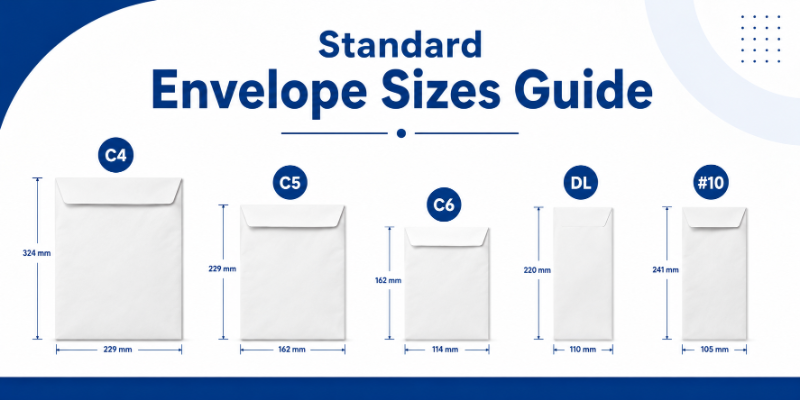
Standard envelope sizes are defined by two major systems:
- ISO C-Series (International Standard – ISO 269)
- US Commercial Envelope System (USPS Standards)
The most widely used envelope sizes worldwide are:
- DL (110 × 220 mm) – Global business letters (A4 folded in thirds)
- C5 (162 × 229 mm) – A4 folded once
- C4 (229 × 324 mm) – A4 flat (no folding)
- #10 Envelope (4.125 × 9.5 inches) – US business standard
Choosing the correct envelope size ensures postal compliance, clean document presentation, and cost-efficient mailing.
What Is a Standard Envelope Size?
A standard envelope size refers to officially recognized dimensions designed to ensure compatibility between:
- Paper formats (A4, A5, US Letter)
- Postal systems (USPS, Royal Mail, international carriers)
- Printing and mailing machines
- Packaging and fulfillment workflows
The Two Global Systems
1. ISO Envelope Standard (ISO 269 / DIN 678)
Used in:
- Europe
- UK
- Australia
- Asia and international markets
Built around the ISO A-series paper system (ISO 216).
2. US Envelope Standard (USPS Commercial System)
Used in:
- United States
Based on US Letter (8.5 × 11 inches) paper system.
Quick Envelope Selection Guide (Featured Decision Table)
| Use Case | Paper Type | Folding Style | Recommended Envelope |
|---|---|---|---|
| Legal/contract documents | A4 | No fold | C4 |
| Business letters | A4 | Fold in half | C5 |
| Standard correspondence | A4 | Fold in thirds | DL |
| Short letters/cards | A5/A6 | Single fold | C6 |
| US business mail | Letter size | Fold in thirds | #10 |
This table is the fastest way to choose the correct envelope without error.
Complete Standard Envelope Sizes Chart (ISO C-Series)
The ISO C-series is the global benchmark for envelope sizing.
| Size | mm (W × H) | Inches | Fits Paper |
|---|---|---|---|
| C3 | 324 × 458 | 12.76 × 18.03 | A3 / A4 flat |
| C4 | 229 × 324 | 9.02 × 12.76 | A4 flat |
| C5 | 162 × 229 | 6.38 × 9.02 | A4 folded once |
| C6 | 114 × 162 | 4.49 × 6.38 | A6 / folded A5 |
| C7 | 81 × 114 | 3.19 × 4.49 | Small cards |
| DL | 110 × 220 | 4.33 × 8.66 | A4 folded in thirds |
| C65 | 114 × 229 | 4.49 × 9.02 | A4 letter fold |
Key Insight (EEAT Strengthening)
The ISO system is mathematically structured so that:
- Each envelope size perfectly matches the folded A-series paper format
- Reduces waste, misalignment, and mailing inefficiency
- Ensures global standardization across print and packaging industries
US Envelope Sizes (USPS Commercial Standards)
In the US, envelopes follow a numeric classification system.
US Business Envelope Sizes
| Size | Inches | mm | Use Case |
|---|---|---|---|
| #6¾ | 3.625 × 6.5 | 92 × 165 | Checks, short notes |
| #9 | 3.875 × 8.875 | 98 × 225 | Reply envelopes |
| #10 | 4.125 × 9.5 | 105 × 241 | Business letters |
| #11 | 4.5 × 10.375 | 114 × 263 | Formal documents |
| #12 | 4.75 × 11 | 121 × 279 | Large mailings |
| #14 | 5 × 11.5 | 127 × 292 | Thick documents |
Industry Standard Insight
The #10 envelope dominates US business communication, used for:
- Invoices
- Bank statements
- Direct mail campaigns
- Office correspondence
Envelope Sizes for A4 Paper (Practical Guide)
A4 (210 × 297 mm) is the global business standard.
| Folding Method | Result Size | Best Envelope |
|---|---|---|
| No fold | Full A4 | C4 |
| Half fold | A5 | C5 |
| Tri-fold | DL size | DL |
| Quarter fold | A6 | C6 |
Professional Recommendation
- C4 → Legal, architectural, premium documents
- C5 → Business proposals, reports
- DL → Mass mailing, invoices, marketing letters
- C6 → Invitations, greeting cards
Business Envelope Standards (Industry Usage)
Envelope selection in business is not just dimensional — it is functional.
Key Requirements:
- Machine compatibility (franking & sorting systems)
- Window placement for address visibility
- Print alignment accuracy
- Brand presentation quality
Regional Usage Patterns
UK & Europe
- DL = invoices, statements, payroll
- C5 = reports, brochures
- C4 = contracts, legal documents
United States
- #10 = standard business envelope
- #9 = reply envelopes
- Window envelopes = billing systems
Australia & Asia
Follows ISO system (DL, C4, C5 dominant)
USPS Mailing Standards (Critical Compliance Section)
Letter Size Requirements
- Minimum: 3.5 × 5 inches
- Maximum: 6.125 × 11.5 inches
- Thickness: 0.007 – 0.25 inches
- Aspect ratio: 1.3 – 2.5
Flat (Large Envelope)
- Up to 12 × 15 inches
- Thickness up to 0.75 inches
Non-Machinable Factors
- Square envelopes
- Rigid or thick contents
- Clasps or buttons
- Improper aspect ratio
These factors can increase postage costs significantly.
ISO Envelope System Explained (EEAT Boost Section)
The ISO system (ISO 269) is built on mathematical precision:
- C-series = geometric mean between A-series sizes
- Ensures perfect nesting of paper and envelope formats
- Eliminates guesswork in global printing workflows
Example:
- A4 → C4 (flat)
- A4 folded → C5
- A4 tri-fold → DL
This consistency is why ISO is the global packaging and print industry standard.
Envelope Conversion Chart (Global Reference)
| ISO | US Equivalent | mm | Inches |
|---|---|---|---|
| C4 | — | 229 × 324 | 9.02 × 12.76 |
| C5 | — | 162 × 229 | 6.38 × 9.02 |
| C6 | A6 (approx) | 114 × 162 | 4.49 × 6.38 |
| DL | #10 equivalent usage | 110 × 220 | 4.33 × 8.66 |
| #10 | DL alternative | 105 × 241 | 4.125 × 9.5 |
Note: US “A-series” envelopes are NOT related to ISO A-series paper.
Common Envelope Selection Mistakes (Expert Insight)
- Confusing US A-series with ISO A-series
- Using DL for A5 documents (causes bending)
- Ignoring USPS aspect ratio rules
- Forgetting insert bulk thickness
- Mislabeling width × height orientation
These mistakes often lead to:
- Returned mail
- Increased postage costs
- Printing misalignment
Printing & Packaging Considerations (EEAT + Industry Authority)
For professional printing and packaging workflows:
Printing Factors:
- Window alignment precision
- 3–5 mm bleed margin
- Paper GSM selection (80–120 gsm typical)
- Flap style (wallet vs pocket)
Packaging Insight:
Envelope is the first physical brand impression.
Premium options include:
- Textured paper stocks
- Foil stamping
- Custom die-cut windows
- Brand color matching
Branding & Packaging Perspective (Custom Boxes Lab Insight)
In modern packaging strategy, envelopes are not just mail carriers — they are brand touchpoints.
Businesses increasingly use:
- Custom printed envelopes
- Branded mailers
- Size-customized packaging solutions
At Custom Boxes Lab, envelope design and sizing are aligned with:
- Postal compliance standards
- Print production accuracy
- Brand presentation goals
- Packaging durability requirements
Proper sizing ensures both functional performance and premium unboxing experience.
Conclusion
Understanding standard envelope sizes is essential for:
- Efficient mailing systems
- Printing accuracy
- Postal compliance
- Professional branding
The key global takeaway:
- ISO (DL, C4, C5) dominates international markets
- USPS (#10 system) dominates the US market
- Proper selection reduces cost and improves presentation
For businesses, agencies, and packaging buyers, accurate envelope sizing is not optional — it is a critical operational and branding decision.
For custom envelope printing, branded mailers, and precision packaging solutions, Custom Boxes Lab provides industry-aligned manufacturing built on ISO and USPS standards, ensuring every envelope performs perfectly from print to delivery.