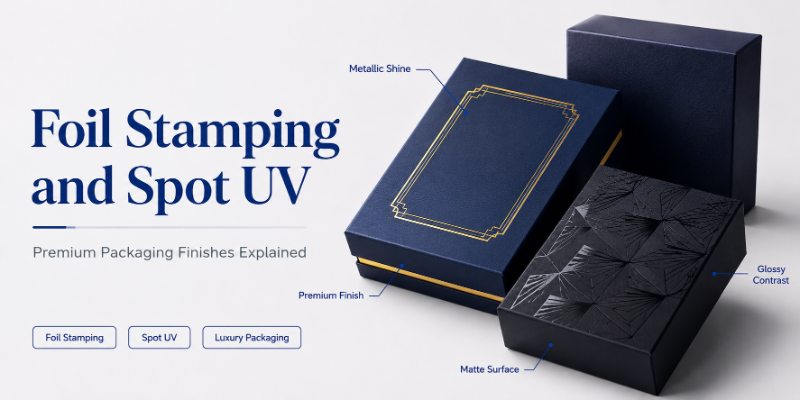
Long before a customer reads a single line of copy on a box, they notice the shine, the texture, and the contrast between glossy and matte areas. That first impression happens in seconds, and it shapes how premium a product feels before anyone opens it.
Foil stamping and spot UV are two of the most requested finishes in custom packaging, and brand owners often assume they’re interchangeable. They’re not. Each creates a different visual effect, suits different materials, and fits different branding goals. This guide breaks down how both work, where they shine, and how to choose between them.
What Are Foil Stamping and Spot UV?
Foil stamping transfers a thin layer of metallic or colored foil onto selected areas of packaging using heat, pressure, and a custom die. Spot UV applies a glossy, clear UV coating to selected areas, creating shine and contrast rather than color. Both are print finishing techniques used to make custom printed boxes feel more premium, polished, and retail-ready.
Foil Stamping vs Spot UV
| Finish Type | Visual Effect | Texture | Best For | Notes |
|---|---|---|---|---|
| Foil stamping | Metallic, reflective shine | Smooth, slightly raised | Logos, luxury boxes, jewelry, gifts | Strong standalone brand impact |
| Spot UV | Glossy, non-metallic contrast | Smooth, subtle raised feel | Matte packaging, modern retail boxes | Works well with minimal branding |
| Foil stamping with embossing | Metallic shine with dimensional depth | Raised, textured | High-end cosmetic and jewelry boxes | Adds a tactile luxury cue |
| Spot UV with matte lamination | Glossy highlight on matte base | Contrast between matte and gloss | Minimal luxury packaging | Clean, contemporary branding |
| Combined foil stamping and spot UV | Metallic plus glossy accents | Multi-textured | Premium rigid boxes, limited editions | Layered, high-impact presentation |
Foil Stamping Meaning
At its core, foil stamping means applying a metallic or colored foil finish to specific parts of a design rather than the whole surface. It’s most commonly used on logos, brand names, icons, borders, seals, and premium typography.
Because the foil sits as a distinct reflective layer, it draws attention immediately and gives a design a finished, high-end look. This is why so many luxury boxes lean on a metallic foil finish for their branding rather than standard ink printing.
What Is Spot UV Printing?
Spot UV printing uses a clear glossy coating applied only to selected parts of a design, leaving the rest of the surface matte, soft-touch, or uncoated. The result is a glossy UV coating that stands out through light reflection rather than color.
Spot UV can create a subtle tactile difference, especially when applied over matte or soft-touch surfaces. Customers often notice it by touch before they consciously register it visually, which is part of why it works so well on minimal, modern packaging.
Hot Foil Stamping Explained
Hot foil stamping is the traditional process behind most metallic finishes. A heated die presses foil film onto the packaging surface using pressure, transferring the foil in the exact shape of the design.
This hot foil finish is durable and holds up well over time, which is why it’s a go-to choice for luxury packaging, cosmetic boxes, jewelry boxes, gift boxes, and rigid boxes where both appearance and longevity matter.
Cold Foil Stamping Explained
Cold foil stamping is a related but different technique. Rather than using heat, it relies on adhesive and pressure to bond foil to the surface, and it’s typically run inline with high-speed offset printing.
As a result, cold foil is often chosen for large production runs where speed matters, or when foil needs to be combined with detailed process-color printing. However, availability depends on the printer’s equipment, the material being used, and how the artwork is set up — so it’s worth confirming with your packaging supplier early in the process.
Spot UV Coating Explained
Spot UV coating differs from full gloss coating in one important way: coverage. Full gloss coats the entire box surface, while spot UV coating targets only chosen design elements, leaving the rest matte or uncoated.
This selective gloss coating works best when used with contrast and restraint. A small glossy highlight against a matte background reads as intentional and premium; covering too much of the design in UV varnish tends to flatten the effect.
Foil Stamping vs Embossing
These two are often confused, but they solve different problems. Foil adds metallic or colored shine to a flat surface. Embossing raises the design so it sits above the surrounding surface, adding dimension without necessarily adding color. Debossing does the opposite, pressing the design inward for a subtler, pressed-in effect.
Combining foil stamping with embossing creates a raised metallic effect that adds both shine and texture, which is a common choice for high-end cosmetic and jewelry packaging.
Foil Stamping vs Spot UV vs Special Colors
It helps to think of these as three separate tools rather than competing options. Foil stamping adds a distinct metallic or reflective material to the surface. Spot UV adds glossy clear contrast without changing color. Special colors, such as PMS inks, deliver precise, consistent brand color without any added shine or metallic effect.
Brand color accuracy calls for special colors, since they deliver precise, consistent results without added shine. Shelf visibility and metallic brilliance are best served by foil stamping. For a subtler, modern contrast, spot UV tends to fit best.
Best Uses for Foil Stamping
- Logos and brand names
- Luxury product boxes
- Cosmetic packaging
- Jewelry boxes
- Gift packaging
- Limited edition packaging
- Invitation or certificate packaging
- Foil stamping cards and stationery
Best Uses for Spot UV
- Matte packaging contrast
- Logo highlights
- Background patterns
- Product names
- Minimal luxury packaging
- Modern retail boxes
- Ecommerce inserts and mailers
Can Foil Stamping and Spot UV Be Used Together?
Yes, and when planned at the design stage rather than added afterward, combining both finishes can produce some of the most striking results in custom packaging. A gold foil logo paired with a spot UV pattern, a soft-touch box with a metallic foil brand name, a matte black box with glossy UV texture, or a rigid luxury box using both accents are all common, effective combinations.
Materials That Work Best
- White paperboard
- Kraft paper
- Corrugated board
- Rigid board
- Cardstock
- Coated paper
- Matte laminated surface
- Soft-touch laminated surface
Foil works best on smooth, even paper stocks, since texture or fiber can interrupt fine detail. Spot UV raises a smooth glossy varnish layer that contrasts most clearly against matte or soft-touch surfaces. Because results vary by material, requesting a sample or proof before full production is a practical step worth taking on any premium packaging finishes project.
Cost Factors for Foil Stamping and Spot UV
Foil stamping cost and spot UV pricing depend on several variables rather than a fixed rate:
- Order quantity
- Artwork complexity
- Die cost for foil stamping
- Total UV coating area
- Material selection
- Number of finishing layers
- Proofing or sample cost
- Setup charges
- Production timeline
Because pricing varies by supplier, quantity, material, and finish area, it’s best to request a quote based on your specific artwork rather than relying on general estimates.
Design and Artwork Setup Tips
- Keep foil details large enough to remain readable after stamping
- Use spot UV where the contrast will actually be visible
- Avoid overcrowding the design with too many finished elements
- Prepare separate finishing layers in your artwork files
- Keep important elements inside the safe area
- Use high-resolution artwork throughout
- Check dielines, bleed, and proofs carefully before approval
- Request a sample for any premium packaging finishes project
Foil Colors and Spot UV Effects
Foil options:
- Gold foil
- Silver foil
- Rose gold foil
- Copper foil
- Black foil
- Colored foil
- Holographic foil
Spot UV effects:
- Glossy logo
- Raised-style gloss effect
- Pattern highlight
- Watermark effect
- Clear varnish shine
- Modern contrast finish
Which Packaging Products Use These Finishes?
- Cosmetic boxes
- Candle boxes
- Jewelry boxes
- Perfume boxes
- CBD boxes
- Chocolate boxes
- Gift boxes
- Rigid boxes
- Business card and stationery packaging
Common Mistakes to Avoid
- Using foil on very tiny text
- Applying spot UV without enough contrast to be visible
- Overusing shiny effects across the design
- Choosing the wrong material for the intended finish
- Ignoring material compatibility before finalizing artwork
- Not preparing separate finishing layers
- Forgetting bleed and safe areas
- Copying competitor designs too closely
- Ordering full production without proofing first
How to Choose the Right Finish
- Choose foil for metallic luxury impact
- Choose spot UV for glossy contrast without added color
- Choose embossing for raised texture
- Choose PMS or special colors for accurate brand color
- Use both foil and spot UV together for high-end packaging
- Match the finish to product category, budget, artwork, and customer expectations
Foil Stamping and Spot UV Packaging by Custom Boxes Lab
Custom Boxes Lab works with brands to develop custom packaging that includes foil stamping, spot UV printing, matte and gloss lamination, soft-touch coatings, embossing, and debossing across rigid boxes, retail boxes, and premium paperboard packaging.
Need packaging with the right premium finish? Custom Boxes Lab can help you choose foil stamping, spot UV, or a combined finish based on your product, material, artwork, and budget.
Final Verdict
Foil stamping creates metallic shine that draws attention and signals permanence. Spot UV creates glossy contrast that highlights detail without adding color. Both are effective print finishing techniques, and both work best when matched with the right material, artwork, and packaging goal rather than applied simply for the sake of shine.