When office archives start overflowing, the problem usually isn’t storage space — it’s wrong box dimensions. Files buckle, lids refuse to close, and stacked cartons slowly turn into unstable towers.
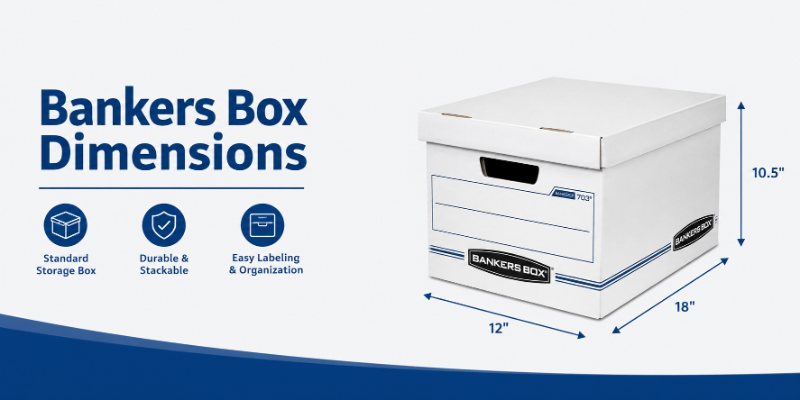
In most cases, these issues come down to a simple misunderstanding of bankers box dimensions and how internal usable space differs from external measurements.
This guide breaks down everything from standard sizing and file capacity to corrugated engineering and stacking safety — written from a packaging engineering and archival systems perspective so you can choose the right box the first time.
What Is a Bankers Box?
A bankers box is a corrugated cardboard storage container designed specifically for document filing, archiving, and office record management.
Unlike regular shipping cartons, these boxes are engineered with precise internal proportions to fit:
- Suspension files
- A4 document stacks
- Legal-size folders
- Lever arch binders
They are widely used in:
- Corporate offices
- Law firms
- Healthcare institutions
- Government archives
- Educational and financial sectors
Why sizing matters
Even a 0.5–1 inch mismatch in dimensions can:
- Prevent file suspension systems from fitting properly
- Reduce stack stability
- Cause lid failure under load
- Waste storage shelf space
That’s why understanding exact archive storage box dimensions is critical before bulk purchasing.
Internal vs External Bankers Box Dimensions (Critical Section)
One of the most overlooked engineering factors in packaging is the difference between internal and external sizing.
External dimensions
These are the measurements printed on packaging:
- Length × Width × Height of the assembled box
- Includes corrugated wall thickness
Internal dimensions
These represent the actual usable storage space.
Corrugated walls reduce usable space by:
- ~6–8 mm per side (single-wall B-flute)
- Up to ~10–12 mm per side (double-wall BC-flute)
Real example
A box listed as:
15″ × 12″ × 10″ (external)
May provide:
~14.5″ × 11.5″ × 9.5″ (internal usable space)
Engineering insight
This difference becomes critical when:
- Matching boxes with shelving systems
- Storing legal-size files
- Using suspension filing rails
Always request bankers file storage box measurements in inches (internal) when ordering in bulk.
Standard Bankers Box Size Chart
While variations exist across manufacturers, most industrial packaging follows standard sizing conventions.
| Box Type | Dimensions (L × W × H) | Use Case |
|---|---|---|
| Standard Archive Box | 15″ × 12″ × 10″ | Office filing & general archives |
| Large Capacity Box | 24″ × 12″ × 10″ | Bulk document storage |
| Compact Office Box | 12″ × 15″ × 9″ | Desktop or limited space storage |
| Heavy Duty Archive Box | 15″ × 12″ × 12″ | Long-term or high-load storage |
The 15″ × 12″ × 10″ format remains the most widely used configuration in global office environments.
Corrugated Board Grades (Engineering Behind the Strength)
The performance of a bankers box is determined more by board structure than size.
B-Flute (Single Wall)
~3mm thickness
Standard office use
Moderate stacking strength
C-Flute (Single Wall)
~4mm thickness
Better cushioning
Mid-range archival use
BC-Flute (Double Wall)
~6–7mm combined thickness
High compression resistance
Ideal for long-term archive storage
Engineering takeaway
For long-term document archive storage box dimensions, BC-flute is the professional standard due to:
- Higher edge crush resistance
- Better humidity tolerance
- Improved stacking stability
File Capacity Guide (Real-World Usage)
Capacity depends on file type and packing method.
Standard 15″ × 12″ × 10″ box holds:
- A4 sheets (80gsm): ~1,500–2,000 sheets
- Suspension files: 5–7 fully loaded folders
- Lever arch binders: 2–3 standard 70mm binders
- Legal folders: 6–8 upright manila folders
Engineering rule
Never exceed 80–85% fill capacity to:
- Maintain structural integrity
- Prevent lid bulging
- Improve stacking safety
A4 vs Legal Size Compatibility
A4 documents (210 × 297 mm)
- Fit comfortably in standard 12″ width boxes
- Suitable for suspension filing systems
- Ideal for international offices
Legal documents (8.5″ × 14″)
- Fit in 15″ standard boxes with limited clearance
- Better suited for extended 24″ boxes in filing systems
US Letter format
- Most flexible
- Fits in all standard bankers box configurations
Practical recommendation
For mixed document environments, the 15″ × 12″ × 10″ format provides the best balance of compatibility and storage efficiency.
Stacking Strength & ECT Ratings
Stacking safety is defined by the Edge Crush Test (ECT) — a key packaging engineering standard.
ECT basics:
- Measures vertical compression strength
- Higher rating = stronger stacking capability
Typical ratings:
- 23–32 ECT → Standard office boxes (3–4 stack height)
- 44–51 ECT → Heavy-duty archive cartons (5–7+ stack height)
Environmental impact
- Humidity can reduce strength by up to 70%
- Moist environments significantly weaken corrugated fibers
Safety guidelines:
- Do not mix partially filled and full boxes in stacks
- Ensure lids are fully engaged
- Avoid floor moisture and uneven surfaces
Bankers Boxes vs Archive Cartons vs Storage Boxes
Bankers boxes
- Designed for documents
- Standardized dimensions
- Optimized for shelving and filing systems
Archive cartons
- Larger industrial storage units
- High structural rigidity
- Used for long-term warehouse storage
Standard storage boxes
- General-purpose cartons
- Inconsistent sizing
- Not optimized for file systems
Key difference
Only bankers boxes are engineered specifically for document storage systems and suspension filing compatibility.
Buying Guide (Use Case Based)
Home office
Compact B-flute boxes for occasional access and light document loads.
Corporate archives
Standard 15″ × 12″ × 10″ BC-flute boxes for structured long-term storage.
Legal firms
Extended or reinforced boxes for legal-size documents and frequent retrieval.
Warehouse storage
High ECT-rated double-wall boxes for multi-layer stacking systems.
Moving offices
Bankers boxes outperform moving cartons due to:
- Better rigidity
- Easier labeling
- Shelf compatibility after relocation
Final Verdict
Choosing the correct bankers box dimensions is not just a packaging decision — it directly affects storage efficiency, document safety, and long-term archive performance.
The 15″ × 12″ × 10″ standard format remains the industry benchmark because it balances:
- File compatibility
- Structural strength
- Storage efficiency
- Cost-effectiveness
However, real optimization comes from understanding internal dimensions, board grade selection, and stacking limits — not just box size alone.
For businesses requiring custom sizing, reinforced structures, or branded archival systems, Custom Boxes Lab provides engineered corrugated solutions designed for precise dimensional and load-bearing requirements.