Getting business card dimensions right is one of the first steps in creating a professional print-ready card. For most businesses in the United States, the standard business card size is 3.5 × 2 inches. This size fits common wallets, card holders, desk organizers, and the expectations people already have when exchanging cards at meetings, events, and trade shows.
However, the final card size is only part of the setup. Bleed, trim size, safe area, artwork resolution, color mode, paper stock, and finish choices also affect the final print result. When these details are handled correctly, your card looks clean, sharp, and professional. When they are ignored, you may see white edges, cut-off text, poor QR code placement, or layout issues after trimming.
Business Card Size Chart
| Card Type | Dimensions in Inches | Dimensions in MM | Dimensions in CM | Best Use |
|---|---|---|---|---|
| US standard business card | 3.5 × 2 | 88.9 × 50.8 | 8.89 × 5.08 | Most US business and networking use |
| UK/EU business card | 3.35 × 2.17 | 85 × 55 | 8.5 × 5.5 | UK and European printing references |
| Square business card | 3.5 × 3.5 | 89 × 89 | 8.9 × 8.9 | Creative brands and premium layouts |
| Mini business card | 3.5 × 1.5 or similar | Varies | Varies | Minimalist branding and short details |
| Folded business card | 3.5 × 4, folded to 3.5 × 2 | 88.9 × 101.6 | 8.89 × 10.16 | Extra information, services, or offers |
| Rounded corner business card | 3.5 × 2 with corner radius | 88.9 × 50.8 with radius | 8.89 × 5.08 with radius | Modern and polished appearance |
| Vertical business card | 2 × 3.5 | 50.8 × 88.9 | 5.08 × 8.89 | Portrait layouts and modern branding |
| Custom business card | Varies | Varies | Varies | Luxury, event, loyalty, or specialty use |
Business Card Dimensions in Inches
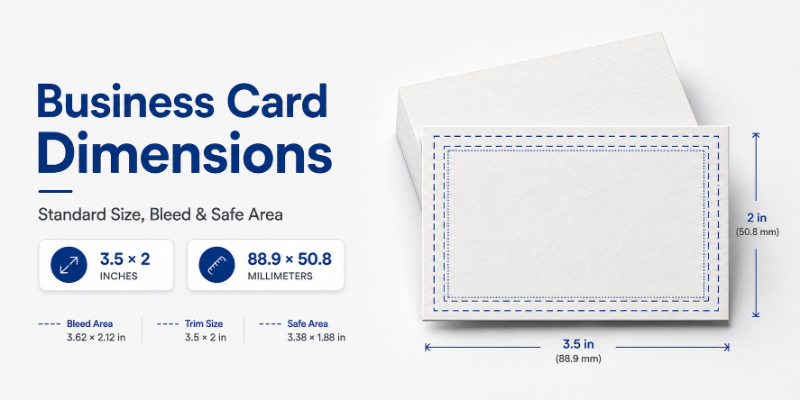
For US printers, inches are the main measurement unit. The standard business card dimensions in inches are 3.5 × 2 inches. Designers usually set up the finished card at this trim size, then add bleed around the outside.
If the card includes bleed, the print-ready business card size becomes 3.75 × 2.25 inches. This includes 0.125 inches added to the left, right, top, and bottom edges.
When setting up a design file, confirm whether your template shows the trim size only or the full size with bleed. This small detail helps avoid artwork setup mistakes.
Business Card Dimensions in MM
The standard US business card dimensions in mm are 88.9 × 50.8 mm. Millimeters are useful when working with international designers, print vendors, or software settings that require more precise measurement.
Bleed in metric format is commonly 3.175 mm on each side. With bleed included, a US standard card becomes approximately 95.25 × 57.15 mm.
Because small rounding differences can happen during conversion, it is best to follow your printer’s exact template rather than manually converting dimensions each time.
Business Card Dimensions in CM
The standard US business card dimensions in cm are 8.89 × 5.08 cm. Centimeters are less common for print setup in the United States, but they are helpful for quick reference.
A business card with bleed measures about 9.525 × 5.715 cm. For professional artwork, inches or millimeters are usually more accurate than centimeters, especially when setting bleed, trim lines, and safe area margins.
What Are Business Card Dimensions?
Business card dimensions describe the length and width of the finished printed card. In the United States, the most common final size is 3.5 inches wide by 2 inches tall. This finished size is also called the trim size because it is the size the printer cuts the card to after printing.
Three print terms matter most when setting up business card artwork:
Trim size is the final size of the card after cutting.
Bleed is the extra artwork area that extends beyond the trim line.
Safe area is the inner space where important content should stay.
If your design includes a background color, image, pattern, or full-edge graphic, that artwork should extend into the bleed. If your logo, phone number, email, website, or QR code sits too close to the edge, it may be affected by normal cutting movement. Understanding these terms helps reduce common print issues before production starts.
Standard Business Card Size in the USA
The standard business card size in the USA is 3.5 × 2 inches. In millimeters, that equals 88.9 × 50.8 mm. In centimeters, it equals 8.89 × 5.08 cm.
For print-ready artwork, most US printers recommend adding 0.125 inches of bleed on all sides. That means a standard US business card file with bleed should be 3.75 × 2.25 inches. Important text, logos, contact details, and QR codes should stay at least 0.25 inches inside the trim edge.
These measurements help your design stay clean, readable, and safer for professional trimming.
Standard Business Card Size Explained
The standard business card size in the USA is 3.5 × 2 inches. This size is widely used by US businesses because it is practical, familiar, and supported by most print templates. It is large enough for a name, title, logo, phone number, email, website, and basic brand details, but small enough to fit easily into wallets and card holders.
For most businesses, this standard size is the best choice. It works well for real estate agents, consultants, contractors, salons, restaurants, medical offices, packaging companies, designers, lawyers, accountants, and local service providers. It also keeps printing simple because most US printers already have templates for this size.
Outside the United States, business card sizes may vary. Many UK and European printers commonly use 85 × 55 mm, which is slightly different from the US standard. Always confirm the final trim size with your printer before finalizing artwork, especially when working with international vendors.
Standard Business Card Measurements by Region
Business card sizes are not the same everywhere. Here are common regional references:
- USA and Canada: 3.5 × 2 inches
- UK and Europe: commonly 85 × 55 mm
- Australia: commonly 85 × 55 mm
- Japan: commonly 91 × 55 mm
These sizes are helpful for comparison, but they should not replace your printer’s specifications. Always confirm exact trim size with your printer before finalizing artwork.
Business Card Bleed Size
Business card bleed size refers to the extra artwork that extends past the final trim edge. This area is cut off during finishing, but it helps prevent thin white borders from appearing if the cutting position shifts slightly.
For most US business cards, the standard bleed is 0.125 inches on all sides. This equals 3.175 mm. A standard 3.5 × 2 inch card with bleed should be set up as 3.75 × 2.25 inches.
Any background color, image, pattern, texture, or edge-to-edge design should extend into the bleed area. Do not stop backgrounds exactly at the trim line. Extending artwork into the bleed gives the printer extra room for trimming and helps the finished card look clean.
Business Card Safe Area
The business card safe area is the space inside the trim line where important content should stay. For a standard US business card, keep text, logos, phone numbers, email addresses, websites, icons, and QR codes at least 0.25 inches from the trim edge.
Keeping important content inside this margin reduces the risk of text, logos, or QR codes being trimmed. It also gives your card better visual spacing and makes the layout easier to read.
QR codes need extra care. They should not sit close to the edge, and they need enough clear space around them for reliable scanning. Small text should also stay inside the safe area, especially if it includes contact details or legal information.
Bleed, Trim Line, and Safe Area: What Is the Difference?
| Print Term | Meaning | Why It Matters | Design Tip |
|---|---|---|---|
| Bleed | Extra artwork outside the trim line | Helps prevent white edges after cutting | Extend backgrounds and images into bleed |
| Trim line | The final cut edge of the card | Defines the finished card size | Keep it at 3.5 × 2 inches for US standard |
| Safe area | Inner zone for important content | Reduces risk of content being trimmed | Keep key details 0.25 inches from the edge |
| Margin | Visual spacing around content | Improves readability and balance | Use enough space around text and logos |
| Final size | Finished printed card size | Shows what the customer receives | Confirm size before printing |
Why Business Card Dimensions Matter for Branding
Business card dimensions affect both appearance and usefulness. A standard-size card feels familiar, fits easily into wallets, and works well in card holders. This makes it practical for networking and everyday business use.
Size also affects layout. A 3.5 × 2 inch card gives limited space, so every design choice matters. Your logo, name, job title, phone number, email, website, and social details need a clear hierarchy. If the card is overcrowded, it becomes harder to read.
Custom dimensions can create a stronger impression for creative or luxury brands, but they should serve a clear purpose. A card that looks unique but does not fit standard storage may be less useful for the person receiving it.
Choosing the Right Business Card Size
- Choose the standard size for most US businesses, service providers, and corporate use.
- Choose square cards for creative brands, boutiques, artists, or premium presentations.
- Choose folded cards when you need extra space for services, appointment details, or offers.
- Choose mini cards for minimalist branding or simple contact sharing.
- Choose vertical cards for modern layouts and portrait-style designs.
- Choose custom cards for luxury branding, events, loyalty programs, or specialty networking.
The best size is the one that supports your brand while staying practical for printing, carrying, and storage.
Business Card Design Tips for Better Printing
- Use 300 DPI artwork for sharp print quality.
- Use CMYK color mode instead of RGB.
- Keep font sizes readable, especially for contact details.
- Keep important content inside the safe area.
- Avoid placing QR codes close to the trim edge.
- Use strong contrast between text and background.
- Do not overcrowd the card with too much information.
- Design the front and back with a clear purpose.
- Check spelling, phone numbers, email, website, and logo placement.
- Review the final proof before approving production.
Printer tolerance can vary by equipment, paper stock, and finishing method. A clean file with proper bleed and safe margins gives your business card a better chance of printing as intended.
Paper Stock and Finish Options
Paper stock affects how your business card feels in hand. In the United States, common business card cardstock options include 14pt, 16pt, 18pt, and 32pt. Standard cards often use 14pt or 16pt stock, while thicker premium cards may use 18pt or 32pt stock.
Some printers may also describe paper weight as 80 lb, 100 lb, or similar cardstock weights, depending on their specifications. Always compare thickness, finish, and intended use before choosing.
Common finish options include:
- Matte finish for a smooth, professional look
- Gloss finish for shine and stronger color impact
- Soft-touch coating for a premium feel
- Foil stamping for metallic logo or accent details
- Spot UV for selective shine on text or graphics
- Embossing and debossing for raised or pressed texture
- Rounded corners for a softer modern style
- Recycled paper for eco-conscious branding
The right business card cardstock and finish should match your brand image, budget, and practical use.
Common Mistakes to Avoid
- Designing without bleed
- Ignoring the safe area
- Using low-resolution images
- Using RGB instead of CMYK
- Adding too much text
- Using fonts that are too small
- Choosing poor color contrast
- Forgetting key contact details
- Placing QR codes too close to the edge
- Not checking the proof before printing
- Not confirming printer specifications
- Using custom sizes without checking print support
A good business card should be easy to read, easy to carry, and easy to print correctly.
Custom Business Card Dimensions
Custom business card dimensions make sense when the size supports a clear branding goal. Luxury brands, creative agencies, event cards, loyalty cards, appointment cards, and specialty networking cards may benefit from a custom size or shape.
However, custom dimensions have trade-offs. They may not fit standard wallets or card holders. They may cost more to print. Some printers may not support unusual cuts, shapes, or finishing combinations. Custom sizes may also need special templates, die-cutting, or extra production time.
Before choosing a custom format, ask whether the card will still be practical for the person receiving it. A unique size should improve brand recall without making the card difficult to keep.
Custom Business Cards by Custom Boxes Lab
Custom Boxes Lab helps businesses create professional custom business cards with accurate dimensions, print-ready setup, premium cardstock options, custom sizes, and high-quality finishes. Whether you need standard USA business cards or custom business card dimensions, the artwork can be prepared with proper trim size, bleed, safe area, and finish planning.
Business card options can include 14pt, 16pt, 18pt, or 32pt cardstock, matte finish, gloss finish, soft-touch coating, foil stamping, Spot UV, embossing, debossing, rounded corners, and recycled paper options.
Need business cards that match your brand? Custom Boxes Lab can help you create professional cards with the right dimensions, materials, printing, and finishing.
Final Verdict
For most US businesses, the standard business card size is 3.5 × 2 inches. In metric measurements, that equals 88.9 × 50.8 mm or 8.89 × 5.08 cm. These business card dimensions are widely used because they fit wallets, card holders, desk organizers, and common US print templates.
Still, size is only one part of a professional card. Bleed, safe area, trim size, cardstock, finish, proofing, and printer specifications all matter. Use 0.125 inches of bleed, keep important content at least 0.25 inches inside the trim edge, and confirm print requirements before sending artwork to production.