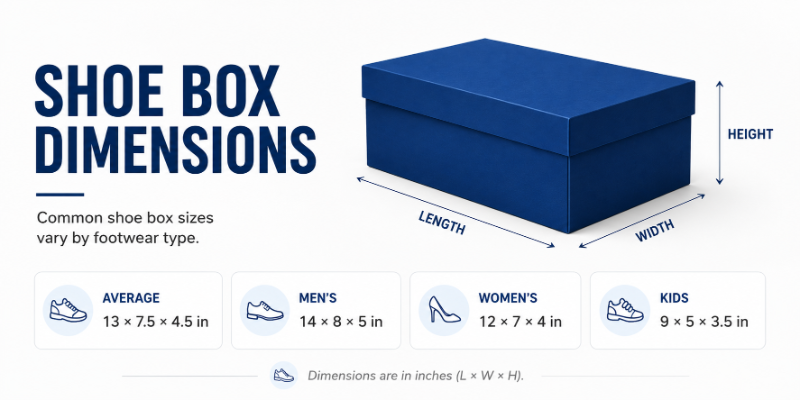
The average adult shoe box measures approximately 13 × 7.5 × 4.5 inches (33 × 19 × 11.5 cm), but that is a baseline, not a rule. Shoe box dimensions vary by footwear type, gender, shoe size, and packaging purpose. Men’s boxes tend to run larger, women’s boxes change in height depending on style, and kids boxes scale down significantly. Understanding these ranges helps brands, retailers, and ecommerce sellers choose the right packaging the first time.
What Are Shoe Box Dimensions?
Shoe box dimensions describe the three measurements that define a box structure: length, width, and height, written as L × W × H.
- Length runs along the shoe from toe to heel — the longest side.
- Width spans the widest horizontal point of the shoe.
- Height measures how tall the closed box stands.
These three numbers determine how well the shoe fits inside, how the box stacks in a warehouse, how it performs during shipping, and how it looks on a retail shelf. Both inches and centimeters are used depending on the market and manufacturing location.
Standard Shoe Box Size Explained
There is no single universal standard that applies to every shoe. What the industry calls a “standard” size is really a set of common ranges developed by footwear manufacturers and retailers over time — useful as a baseline, but not fixed.
Standard sizes work well for high-volume retail runs, shelf planograms, and warehouse systems that depend on consistent dimensions. The moment a product steps outside the typical profile — a tall boot, a platform sneaker, a wide-fit shoe — a standard box often stops being the practical choice.
Shoe Box Size Chart
| Shoe Box Type | Dimensions in Inches (L × W × H) | Dimensions in CM (L × W × H) | Best For | Packaging Notes |
|---|---|---|---|---|
| Average shoe box | 13 × 7.5 × 4.5 | 33 × 19 × 11.5 | General adult footwear | Most versatile retail baseline |
| Men’s shoe box | 14 × 8 × 5 | 35.5 × 20.3 × 12.7 | Sneakers, dress shoes, athletic shoes | Longer and wider for larger sizes |
| Women’s shoe box | 12 × 7 × 4 | 30.5 × 17.8 × 10.2 | Flats, sandals, fashion footwear | Height increases for heels and wedges |
| Kids shoe box | 9 × 5 × 3.5 | 22.9 × 12.7 × 8.9 | Toddler to youth sizes | Compact; lightweight materials work well |
| Sneaker box | 13.5 × 8 × 5 | 34.3 × 20.3 × 12.7 | Athletic shoes, trainers, lifestyle sneakers | Slightly taller for thick soles |
| Boot box | 15 × 9 × 7 | 38.1 × 22.9 × 17.8 | Ankle boots, Chelsea boots, work boots | Extra height; use sturdy board |
| Sandal box | 12 × 7 × 3 | 30.5 × 17.8 × 7.6 | Flip-flops, slides, open-toe sandals | Shallow height; tissue fits easily |
| Heels box | 12.5 × 7 × 5 | 31.75 × 17.8 × 12.7 | Pumps, stilettos, block heels | Height accounts for heel clearance |
| Shipping shoe box | 14 × 9 × 6 | 35.5 × 22.9 × 15.2 | Direct ecommerce shipments | Outer dimension includes padding allowance |
| Custom shoe box | Varies by product | Varies by product | Premium brands, limited editions, unusual silhouettes | Designed to exact product measurements |
Average Shoe Box Dimensions
The average shoe box dimensions across mainstream retail land at 13 × 7.5 × 4.5 inches (33 × 19 × 11.5 cm). This range suits most mid-sized adult shoes and works for standard shelf stacking, common shipping cartons, and general warehouse systems.
It is a useful reference point, not a packaging specification. A brand manufacturing shoes across multiple styles and size ranges needs at least two or three box formats. Always measure the actual footwear — including any insole, tissue, or insert — and add appropriate clearance before finalizing an order.
Shoe Box Dimensions in Inches and CM
In the United States, shoe box dimensions in inches are the standard for packaging specs, print files, and fulfillment operations. Most domestic footwear brands and US-based packaging suppliers communicate measurements in inches. A typical men’s retail box runs 13–14 inches long and 4.5–5 inches tall; women’s boxes fall between 11–13 inches long with height varying by style.
For international brands, global suppliers, and cross-border manufacturing, shoe box dimensions in centimeters are preferred. CM measurements align with ISO sizing conventions across Europe, Asia, and South America, and they reduce conversion errors when coordinating with overseas factories. A standard adult box at 33 × 19 × 11.5 cm is the same box as 13 × 7.5 × 4.5 inches — the unit depends on the audience.
One important note in either unit: always confirm whether a manufacturer’s quoted dimensions are inner or outer measurements. Box wall thickness — typically 2–4 mm in paperboard — reduces usable interior space, and the difference matters when fitting the shoe.
Shoe Box Dimensions by Footwear Type
Men’s Shoe Box Dimensions
Men’s shoe boxes are the largest standard category, covering US sizes 6 through 16 across dress shoes, sneakers, boots, and athletic footwear. Common dimensions range from 13–15 inches long, 7.5–9 inches wide, and 4.5–6 inches tall (33–38 × 19–23 × 11.5–15 cm). Running shoes and basketball shoes with thick midsoles typically need more height than dress shoes with flat profiles.
Women’s Shoe Box Dimensions
Women’s footwear is the most dimensionally varied category. Flats, sandals, and fashion shoes generally fit boxes measuring 11–13 inches long, 6.5–7.5 inches wide, and 3.5–4.5 inches tall (28–33 × 16.5–19 × 9–11.5 cm). Heels, wedges, and platform shoes push height requirements to 5 inches or more. Tall boots require a different structural format entirely.
Kids Shoe Box Dimensions
Kids boxes scale from compact toddler sizes — as small as 7 × 4 × 3 inches (17.8 × 10.2 × 7.6 cm) — up to near-adult dimensions for older youth sizes. A practical mid-range for children’s footwear is 9 × 5 × 3.5 inches (22.9 × 12.7 × 8.9 cm). Brands covering a full kids size run typically maintain two to three box sizes rather than one format.
Sneaker Box Dimensions
Sneaker boxes are slightly taller and wider than standard dress shoe boxes, accounting for thick rubber soles and padded uppers. A common sneaker box runs 13–14 inches long, 7.5–8 inches wide, and 5–5.5 inches tall. Collector and limited-edition sneaker packaging often uses rigid board for a premium presentation.
Boot Box Dimensions
Boot boxes are the largest format in footwear packaging. Ankle and Chelsea boots typically require a box around 15 × 9 × 7 inches (38.1 × 22.9 × 17.8 cm). Tall shaft or knee-high boots need significantly more height — sometimes 10–14 inches — and benefit from corrugated board for structural support during shipping.
Heels and Sandal Box Dimensions
Heels need more vertical clearance than length alone suggests. A pump or stiletto box is typically 5 inches tall or more to house the shoe without forcing the heel into a bad position. Some brands pack shoes toe-to-heel; others nest them facing opposite directions. Sandal boxes are the shallowest format — 2.5–3.5 inches tall — since the product sits flat with minimal height.
How to Measure a Shoe Box Correctly
- Measure shoe length from toe tip to heel, then add 0.5–1 inch for clearance.
- Measure shoe width at the widest point, then add 0.5 inch per side.
- Measure shoe height when laid flat, then add room for tissue paper or an insert.
- Account for inserts — a cardboard tray, tissue stack, or foam pad adds to interior height requirements.
- Confirm inner vs outer dimensions — wall thickness reduces usable interior space, especially in corrugated board.
- Check shipping requirements — if the shoe box ships without an outer carton, add an external padding allowance to the dimensions.
- Order a sample first — always verify a physical sample before committing to a full production run.
Why Shoe Box Dimensions Matter for Shipping
In ecommerce, box dimensions directly affect cost. Shipping carriers calculate fees using dimensional weight — a formula that factors in box volume alongside actual weight. An oversized shoe box that ships half-empty increases carrier costs on every order.
Beyond cost, correct dimensions reduce product movement inside the box. A shoe that shifts during transit risks creasing, scuffing, or structural damage. The right box size, combined with corrugated board and appropriate filler, eliminates excess movement and keeps the product in shipping condition. For warehouse operations, consistent shoe box sizes also improve stacking efficiency and storage density.
Why Shoe Box Dimensions Matter for Branding
A shoe box is often the first physical contact a customer has with a brand. Box proportions communicate quality before the lid opens. A box sized precisely to the shoe inside feels considered and premium. A box that is obviously too large — with the shoe rattling around inside — undermines that perception regardless of how well the outside is printed.
Correct dimensions also maximize the usable print surface. When the box is built to the right size, logos, product names, and design elements land in proportion and at the right visual weight. For retail environments, box height and footprint determine shelf stacking, facing count, and planogram fit — all factors that affect how a product performs in-store.
Custom Shoe Box Dimensions
Standard sizes cover most everyday footwear, but custom shoe box dimensions are often the better choice for:
- Premium and luxury footwear where the unboxing experience is part of the product value
- Boots with tall shafts that do not fit standard height ranges
- Platform sneakers and chunky soles that need extra height clearance
- Limited-edition releases where distinctive packaging is part of the launch
- Ecommerce-only brands shipping the shoe box directly, without an outer carton
- Subscription boxes and gift sets where the packaging format is part of the experience
Materials Used for Shoe Boxes
- Paperboard / cardboard – The standard for retail shoe boxes. Lightweight, printable, cost-effective, and suitable for most footwear categories.
- Corrugated board – Used for shipping boxes and heavy footwear like boots. The fluted inner layer absorbs impact during transit.
- Kraft paperboard – A natural-texture option popular with eco-positioned brands. Prints well and communicates sustainability.
- Rigid board – Used for premium and luxury footwear packaging. Heavy, sturdy, and associated with high-end unboxing experiences.
- Recycled paperboard – Common across footwear categories as brands respond to sustainability expectations from consumers and retailers.
Printing and Finishing Options for Shoe Boxes
Printing methods: digital printing for short runs, offset printing for high-volume consistency, CMYK for full-color production, and PMS color matching for exact brand color accuracy.
Finishing options: matte lamination, gloss lamination, soft-touch coating, spot UV, foil stamping, embossing, debossing, custom inserts for product positioning, and window cut-outs where the box structure supports them.
The finish choice should match the product tier — a budget shoe and a luxury sneaker have different presentation expectations, and the packaging should reflect that.
How to Choose the Right Shoe Box Size
- Measure the actual footwear before specifying any dimensions
- Match the box format to the shoe type — height requirements vary widely by style
- Leave 0.5–1 inch of interior clearance on all sides
- Add height for tissue paper, inserts, or formed trays
- Avoid oversized boxes — they increase shipping costs and reduce perceived quality
- Choose material based on use case: paperboard for retail, corrugated for shipping
- Check that the box fits the intended shelf format or display system
- Always order a physical sample before approving a production run
Common Mistakes to Avoid
- Using one box size across a full footwear line
- Underestimating box height — the most commonly misjudged dimension
- Confusing inner and outer dimensions when placing a box order
- Choosing board that is too light for the shoe weight and shipping demands
- Overcrowding the design with too many print elements on a small surface
- Forgetting to account for insert or tissue dimensions when calculating interior space
- Ignoring shelf fit — a box that does not match shelf dimensions disrupts retail display
- Skipping a sample order and going straight to bulk production
Custom Shoe Boxes by Custom Boxes Lab
Custom Boxes Lab helps footwear brands, ecommerce sellers, boutique retailers, and private-label companies create custom shoe boxes built to exact dimensions, materials, prints, and finishes. From men’s sneaker boxes and women’s heel packaging to kids shoe boxes and tall boot cartons, we produce footwear packaging across every style and size range.
Need custom shoe boxes built to exact dimensions? Custom Boxes Lab can help you create retail-ready and ecommerce-friendly packaging based on your footwear size, material, printing, and branding needs. Our team handles structural design, full-color printing, lamination, specialty finishes, and custom inserts — all in one place.
Choosing the Right Shoe Box Size
Standard shoe box dimensions are a practical starting point, but the best box for any product is the one designed around the actual shoe. Dimensions affect shipping costs, damage rates, retail presentation, and how a customer perceives the brand at the moment of unboxing. Whether you are working with standard sizes or specifying custom shoe box dimensions, measuring accurately and testing with a physical sample before production is always the right approach.